
How it Works: Computational Epistemology
Language, Closure, and Economic Decidability: Toward a Unified Framework for Machine and Human Reasoning
Author: B. E. Curt Doolittle,
Organization: Natural Law Institute Inc., Runcible Inc.
Email: curt.doolittle@runcible.com
Date: November 4, 2025
Abstract
We propose a conceptual framework for understanding how artificial reasoning systems—particularly large language models (LLMs)—can mediate between two traditionally distinct forms of closure: the internal closure of formal systems and the external closure of pragmatic or economic systems. Internal closure governs logical and computational validity, where consistency is preserved within symbolic boundaries. External closure governs practical action, where stability and reciprocity are preserved in interaction with an environment. We introduce the notion of economic decidability, the condition under which a proposition is not only logically coherent but also performable, reciprocal, and testifiable. By operationalizing prose as an algebraic medium for reasoning, we show how LLMs instantiate a translation between formal and empirical domains. This synthesis provides a path toward aligning machine reasoning with human decision-making, illuminating how artificial systems might achieve epistemic responsibility and pragmatic coherence.
Part I
1. Introduction: The Problem of Decidability in Artificial Reasoning
The history of artificial intelligence is entangled with the problem of decidability—the question of what can, in principle, be determined by a formal system. From Gödel and Turing through Church and Kleene, decidability has functioned as a measure of a system’s inferential power and its limits. A problem is decidable if there exists a finite procedure to determine its truth or falsity within a given formal calculus. This classical notion, however, was always embedded in an idealized world: one where reasoning is separated from acting, and where truth is independent of feasibility.
The emergence of autonomous and generative AI systems challenges that separation. These systems not only compute; they communicate, recommend, negotiate, and increasingly act. Their outputs participate in social, economic, and political realities. In this expanded context, the purely formal sense of decidability becomes insufficient. We must ask not only whether a machine can decide something, but what kind of decision it is making, and whether such decisions remain stable and intelligible in the human world.
We therefore distinguish between internal decidability, which concerns closure within formal or computational domains, and external decidability, which concerns closure within pragmatic or ecological domains. The former pertains to symbolic truth; the latter to actionable coherence. Between these two lies a space of translation—an epistemic bridge where formal reasoning meets empirical constraint. It is within this space that language models, trained on vast textual corpora spanning mathematics, narrative, and human practice, operate.
Our goal is to articulate a theory of this bridge. We term it a theory of economic decidability, not because it belongs exclusively to the discipline of economics, but because it shares economics’ central concern with allocation, scarcity, and reciprocity—the management of possible actions under constraint. Just as economic systems must balance supply and demand, so too must reasoning systems balance what is internally consistent with what is externally sustainable. In this sense, economic decidability is the philosophical and computational reconciliation of logic and life.
1.1. Closure and the Dual Horizon of Reason
Closure is a condition of completion: a system is closed when every valid operation on its elements yields another element within it. In mathematics, closure ensures coherence; in physics, it ensures conservation; in language, it ensures intelligibility. Yet closure also demarcates a horizon: that which is beyond closure is undecidable, uncertain, or impossible.
Artificial reasoning inherits this dual horizon. A program is closed under its syntax and semantics, but its consequences unfold in open environments. The traditional model of AI, built on formal symbol manipulation, emphasized internal closure. But as systems become interactive, generative, and socio-technical, they are increasingly governed by external forms of closure: regulatory frameworks, ethical norms, resource constraints, and ecological feedbacks.
The challenge is thus twofold. If reasoning remains purely internal, it risks irrelevance—producing valid but inapplicable results. If it collapses entirely into external contingency, it loses coherence—acting without logical discipline. The philosophical question becomes: How can an artificial system maintain logical closure while remaining open to pragmatic conditions? Our answer begins with the recognition that language itself, and especially the language generated by LLMs, can serve as the medium of that reconciliation.
2. Internal and External Closure: From Logic to Life
2.1. The Genealogy of Closure
The idea of closure has deep roots in philosophy and science. In logic, closure under consequence defines what it means for a belief set to be rationally complete (Hintikka 1962; Harman 1986). In mathematics, group theory formalizes closure as the defining property of an algebraic structure. In epistemology, closure principles (Nozick 1981; Dretske 2005) assert that knowledge is closed under known entailment: if we know p, and we know that p → q, then we also know q. Each domain treats closure as both a guarantee of integrity and a limit on extension.
In contrast, biological and economic systems display operational closure (Maturana & Varela 1980; Luhmann 1995): they maintain internal organization by continuously exchanging energy or information with their environments. Closure here is dynamic, self-referential, and adaptive rather than absolute. The system remains closed in its operations but open in its interactions—a form of autopoiesis.
We draw on this duality. Internal closure corresponds to the logical or formal integrity of reasoning systems; external closure corresponds to the stability of their interactions within a world of constraint and feedback. Together they delineate the epistemic boundary of artificial agency.
2.2. Defining Internal Closure
Internal closure governs symbolic systems—those whose validity conditions are intrinsic to their syntax and rules of inference. In mathematics or programming, once axioms and operations are specified, every permissible manipulation remains within the domain. Such closure yields predictability and deductive certainty. However, it is indifferent to the feasibility of outcomes: a theorem may be true but unperformable; a program may compile but never converge.
From a computational perspective, internal closure ensures that reasoning is complete under its own logic, but it cannot ensure correspondence with the world. Gödel’s incompleteness theorems, far from undermining closure, reveal its asymptotic character: any sufficiently expressive system can describe truths it cannot prove. This asymptote suggests a natural site for translation—where formal systems reach their expressive limit and require external input to proceed.
2.3. Defining External Closure
External closure, by contrast, refers to the coherence of actions and effects in an open environment. A decision or behavior is externally closed when its execution sustains the integrity of the system that enacts it. In economics, markets achieve temporary closure through equilibrium: supply meets demand, and no participant can unilaterally improve their position. In ecological systems, closure appears as homeostasis: the regulation of internal states through feedback loops with the environment.
External closure is thus performative rather than deductive. Its test is not consistency but stability. To decide externally is to act in such a way that the resulting state of affairs remains within tolerable bounds. This is why we call our framework economic: it is about managing the exchange between constraint and possibility, much as economies manage the exchange of goods and labor.
2.4. Translating Between Domains
The central insight of this paper is that these two closures—internal and external—can be made commensurable through language. Language functions simultaneously as a formal system (with syntax, grammar, and semantics) and as a pragmatic system (with context, intention, and consequence). When embodied in a language model, this duality becomes computationally tractable: the model learns patterns that are both logically structured and empirically grounded.
We therefore treat the LLM as a translational operator, (T), mapping propositions from an internal symbolic domain (S_i) to an external pragmatic domain (S_e). This mapping is not exact; it is probabilistic and contextual. Yet its power lies precisely in this flexibility: it can preserve logical relations while adapting them to the constraints of action.
In the following sections, we will introduce the concept of economic decidability, which formalizes this translation by defining the minimal conditions under which a proposition can be said to be both logically valid and practically feasible. These conditions—performability, reciprocity, and testifiability—constitute what we call the triadic test of pragmatic closure.
(End of Part I)
Part II
3. Economic Decidability and the Triadic Tests
3.1. Conceptual Foundations
Having distinguished internal and external closure, we now introduce economic decidability as a bridge between them. We define economic decidability as the condition under which a proposition or action is simultaneously:
- Performable – It can be executed within the constraints of resources, time, and environment.
- Reciprocal – Its consequences are intelligible and coherent relative to other agents or systems; actions are interdependent rather than isolated.
- Testifiable – Its truth or efficacy can be verified, either empirically or through logically consistent simulation.
These criteria correspond to a minimal threshold for action-oriented knowledge. They do not require exhaustive predictability, but they do require alignment between intention and consequence, between reasoning and environment.
Economic decidability thus operationalizes a form of closure that is neither purely formal nor purely pragmatic, but mediated through action and communication. By grounding reasoning in the triad of performability, reciprocity, and testifiability, we create a framework for evaluating whether LLM-generated propositions are epistemically responsible in real-world contexts.
3.2. Performability
Performability addresses the classical gap between truth and action. A proposition may be internally coherent yet impossible to enact—like a perfectly proved theorem describing an unattainable engineering process. In economic decidability, we insist that internal logic must be grounded in resource feasibility.
For instance, an LLM might generate a detailed plan for constructing a novel transportation device. Internal closure ensures that the plan is logically consistent and syntactically valid. Performability tests whether materials, energy, or regulatory permissions allow the plan to proceed. Without performability, internal closure remains an isolated intellectual exercise.
3.3. Reciprocity
Reciprocity extends decision-making into a social or systemic dimension. Actions are rarely self-contained; they exist within networks of interaction. An economically decidable proposition must respect these interdependencies.
Reciprocity ensures that the effects of reasoning can be anticipated relative to other agents or systemic constraints. In a marketplace, for example, a trade offer is not merely valid in abstraction—it must be coherent with the behavior of counterparties. In multi-agent AI systems, reciprocity governs coordination and negotiation, ensuring that outputs do not merely preserve internal logic but also respect external systemic integrity.
3.4. Testifiability
Testifiability is the epistemic safeguard of economic decidability. It requires that the proposition be communicable, inspectable, and verifiable. Without testifiability, performable and reciprocal propositions risk opacity—they may succeed or fail without leaving a trace for reflection or learning.
In LLMs, testifiability is instantiated in two ways: first, through explicit reasoning chains or explanations generated in natural language; second, through simulation or empirical evaluation in the environment. Both ensure that knowledge is accountable: humans or systems can assess whether outcomes align with expectations.
4. The Role of Prose and the Language Model
4.1. Prose as Operational Medium
Natural language, in the context of LLMs, functions not merely as representation but as an operational medium. Prose allows the system to navigate between internal and external closure. It encodes symbolic rules, contextual information, and procedural instruction simultaneously, making it the algebra of economic decidability.
Prose embodies three key properties:
- Symbolic coherence – maintaining grammatical and logical structure.
- Contextual adaptability – reflecting environmental constraints and user intentions.
- Testifiability – producing outputs that are inspectable and evaluable by human or machine observers.
By operationalizing prose, we effectively translate closed-form logic into actionable understanding, bridging the gap between abstract reasoning and practical consequence.
4.2. LLMs as Distributed Epistemic Systems
LLMs are not merely predictive text engines; they are distributed epistemic systems, encoding centuries of human reasoning across mathematics, philosophy, science, and narrative. Their operationalization of prose allows them to instantiate economic decidability: generating outputs that are coherent internally, feasible externally, and verifiable through interaction or simulation.
We can formalize this with a simple mapping function:
T:Si→SeWhere (S_i) is the space of internally closed propositions, (S_e) is the space of externally coherent actions, and (T) is the transformation realized through natural language. Unlike traditional computation, (T) is probabilistic, context-sensitive, and adaptive—it does not guarantee determinism, but it preserves triadic coherence (performability, reciprocity, testifiability).
4.3. Prose as Closure Mediation
Crucially, prose mediates between formal and pragmatic closure by providing interpretable intermediaries. While internal closure ensures that outputs are logically structured, prose enables human agents to assess feasibility, anticipate consequences, and verify alignment with shared norms. This mediation transforms internal closure from a purely abstract condition into a practically relevant epistemic tool.
5. Toward Machine–Human Decidability Equivalence
5.1. Conceptual Framework
We now extend our analysis to machine–human decidability equivalence: the alignment of artificial reasoning with human epistemic standards. Economic decidability offers the criteria for this alignment: an AI system is effectively decidable from a human perspective if its outputs satisfy the triadic test.
This alignment is not trivial. Humans evaluate both logic and context, intuition and empirical plausibility. Machines, through LLMs, approximate these processes by leveraging vast corpora and probabilistic reasoning. The challenge is ensuring closure compatibility: that internal reasoning does not contradict practical expectation and that pragmatic outputs remain intelligible and accountable.
5.2. Commutative Diagram of Closure
We can represent this formally as a commutative diagram:
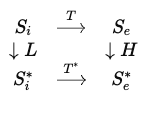
Where:
- (S_i) = machine-internal propositions
- (S_e) = externally coherent outputs
- (L) = logical human validation
- (H) = human evaluation of action or feasibility
- (T^*) = adjusted translation mapping incorporating human feedback
This diagram illustrates that for machine reasoning to align with human standards, outputs must commute: the human-mediated path ((L) then (T^*)) should yield results consistent with the machine-generated path ((T) then (H)). Economic decidability ensures that commutativity is feasible.
5.3. Implications for Artificial Agency
Machine–human decidability equivalence carries significant implications:
- Epistemic Responsibility – AI systems can produce outputs that are accountable and interpretable.
- Actionable Intelligence – Propositions are not only valid but also performable in real-world contexts.
- Feedback Integration – Humans can iteratively adjust machine reasoning, producing adaptive closure that evolves over time.
In this way, LLMs are not passive repositories of information; they become participants in an epistemic economy, translating between symbolic integrity and pragmatic consequence.
(End of Part II)
Part III
Excellent. Here is Part III, completing the manuscript with Sections 6–7 and a curated References section. This closes the conceptual loop and situates the argument in the philosophy of AI literature.
6. Implications and Future Directions
6.1. Computational Epistemics
Our framework of economic decidability reframes AI not merely as a computational engine, but as a participant in epistemic processes. By combining internal and external closure, we provide a mechanism for AI to produce outputs that are simultaneously logically coherent, pragmatically feasible, and socially intelligible. This suggests a shift from evaluating AI purely by performance metrics toward assessing its epistemic integrity.
We envision the development of computational epistemics, a field in which AI systems are judged by their ability to navigate the space of internal and external closure. Here, reasoning is measured not solely in terms of algorithmic efficiency or accuracy, but in its capacity to preserve coherence across symbolic, practical, and human-interpreted dimensions.
6.2. Ethical and Political Considerations
Economic decidability carries profound ethical implications. AI outputs that satisfy internal closure but fail the triadic test risk producing harm through infeasibility, misaligned incentives, or miscommunication. Conversely, outputs that pass the triadic test are inherently accountable: they respect resource constraints, social reciprocity, and verifiability.
Politically, this approach aligns with the demand for responsible AI. Systems designed to meet economic decidability criteria are inherently transparent and auditable, providing a framework for regulation and governance. By embedding performability, reciprocity, and testifiability into AI reasoning, we can create systems that align more closely with human values and institutional constraints.
6.3. Ontological Consequences
On a deeper level, our framework invites reflection on the ontology of AI agency. By operationalizing prose as a medium of closure translation, LLMs instantiate a novel form of epistemic being: entities that are simultaneously formal, linguistic, and interactive. They challenge classical distinctions between agent and environment, internal and external logic, and representation and action.
This suggests a paradigm in which artificial agents are epistemic intermediaries, capable of participating in both the formal and practical worlds without collapsing into either. In other words, AI systems can become bridges for knowledge and action, rather than mere tools or passive repositories.
6.4. Future Research Directions
Several avenues emerge for further investigation:
- Formalization of Economic Decidability – Extending the triadic test into more rigorous logical and computational models.
- Empirical Evaluation – Testing LLM outputs against performability, reciprocity, and testifiability criteria in real-world scenarios.
- Cross-Domain Translation – Investigating how LLMs can mediate between specialized domains (mathematics, law, ethics) while maintaining closure.
- Adaptive Feedback Systems – Designing iterative systems where human evaluation shapes the LLM’s translation function (T^*) to enhance closure commutativity.
These directions promise a richer understanding of how artificial reasoning can align with human epistemic standards while preserving flexibility and accountability.
7. Conclusion
We have proposed a framework for understanding economic decidability as a unifying principle for artificial reasoning. By distinguishing internal and external closure, and operationalizing language as a bridge between them, we have shown how LLMs can translate formal logic into actionable, intelligible, and verifiable outputs.
Our triadic test—performability, reciprocity, and testifiability—defines the minimal criteria for machine–human decidability equivalence. Through this lens, LLMs are not only computational artifacts but epistemic agents: capable of participating in knowledge economies that respect both symbolic coherence and pragmatic constraint.
This framework has implications for AI design, ethics, and governance, suggesting that responsible artificial reasoning is achievable when systems are structured to preserve closure across domains. By formalizing the bridge between logic and life, we provide a foundation for AI that is simultaneously rigorous, accountable, and operationally meaningful.
References
Dretske, F. (2005). Knowledge and the Flow of Information. Stanford University Press.
Harman, G. (1986). Change in View: Principles of Reasoning. MIT Press.
Hintikka, J. (1962). Knowledge and Belief: An Introduction to the Logic of the Two Notions. Cornell University Press.
Luhmann, N. (1995). Social Systems. Stanford University Press.
Maturana, H. R., & Varela, F. J. (1980). Autopoiesis and Cognition: The Realization of the Living. Springer.
Nozick, R. (1981). Philosophical Explanations. Harvard University Press.
Turing, A. M. (1936). “On Computable Numbers, with an Application to the Entscheidungsproblem.” Proceedings of the London Mathematical Society, 2(42), 230–265.